Oisín Tozer
Oisín Tozer is a visual artist based in Dublin. He obtained his BA in Fine Art from Technological University Dublin in 2023.
His practice investigates how we understand and relate to the natural world, through a range of materials, media, and mechanisms of display. His recent projects have been site specific, being developed in response to the ecology and materiality surrounding the gallery.
Tozer draws from research into botany, ecology and art history to develop his works. Elements of this research are embedded into the processes of making, whereby materials are manipulated and combined as a means to question distinctions between nature, culture and technology.
These works form relationships with each other and the space they inhabit, culminating in visually spare, site-responsive installations. Although research forms the starting point for artistic methodologies, the work prioritises the poetic forms of engagement, often dealing with the formal legacies of painting, sculpture and installation.
Tozer makes work from the position of having grown up in rural Ireland and belonging to a generation that will live through the consequences of climate and ecological breakdown. These tensions are reflected in the work, where time is present in a number of different ways, with the works being ephemeral, durational or site-specific.
SOLO EXHIBITIONS
2026 In the Pale Light of a Shadow, Ballina Arts Centre, Mayo IE (Forthcoming)
2026 Breathing in the Dark, Green on Red Gallery, Dublin IE
2026 A Fragile Line The Lab Gallery, Dublin IE
2025 A Brightness at the Edge of Things, Apsara Studio, London UK
2025 yearn Richmond Road Studios, Dublin IE
2025 Desiring Machines, Hyde Bridge Gallery, Sligo IE
GROUP EXHIBITIONS
2026 Avant Garnder, Naughton Gallery, Belfast NI (Forthcoming)
2026 Look how Brightly, Hypha Studios, London UK (Forthcoming)
2025 New Artists New Work, Green on Red Gallery, Dublin IE
2025 Right here, Right now, Rua Red, Dublin IE
2025 Earthly Delights, Green on Red Gallery, Dublin IE
2025 The cosmos, the Earth and us, A4 sounds, Dublin IE
2025 Damp, Humid Growth, Catalyst Arts, Belfast NI
2024 Daisy Daisy, The Complex Gallery, Dublin IE
2024 Echoes of Home, Royal Hibernian Academy, Dublin IE
2023 RDS Visual Art Awards, IMMA, Dublin IE
2023 GradX, Technological University Dublin, Dublin, IE
AWARDS
2025 Culture Ireland Regular Grant Award
2023 RC. Lewis Crosby Award at the 2023 RDS Visual Art Awards
2023 Arts Council of Ireland Agility Award
2023 Dublin School of Creative Arts Academic Achievement Award
2023 TU Dublin School of Fine Art Best Thesis award
TALKS AND EXPERIENCE
2026 In conversation with Dr. Mark Garry, The LAB Gallery, Dublin IE
2025 Panellist on the cultural impact of the RDS awards, RHA Gallery, Dublin IE
2024 Douglas Hyde Gallery student Forum IV
2024 IMMA lunchtime talks series, IMMA, Dublin IE
2018 Work experience at The Model Gallery, Co. Sligo
RESIDENCES
2024 Richmond Road Studios Graduate Award
2023 Fire Station Artist Studios Digital Media Graduate Award
2023 Graphic Studio Dublin Graduate Residency award
2023 Cill Rialaig Graduate Residency Award
PRESS
Oisín Tozer’s first solo exhibition in the UK occupies a former fireplace shop. The setting is significant. Traditionally, fireplaces are where wood, coal and turf – vegetal matter in varying states of decay and fossilisation – are transformed into heat and light via the chemical process of combustion. Energy from ancient sunlight, absorbed by chlorophyll, is reborn as fire; carbon trapped for up to millions of years is released into the air; the room becomes warmer, more welcoming; and the climate edges infinitesimally closer to collapse.
These walls, across which one can easily imagine shadows being wrought by the play of flame, are home to a pair of carved, site-specific murals, one at the front and another to the rear of the gallery. Unlike the vegetal matter combusted in fireplaces, Tozer’s works depict living, even flourishing things: fragile, abundant weeds. To make these pieces, the artist first collected, identified, photographed and sketched the weeds he found in the gallery’s courtyard. Growing in the cracks – on the edges – they form lines of frothing green that soften, perhaps subvert, the cobblestones’ linear patterning.
Tozer’s interest in weeds stems in part from their often rhizomatic stem systems. Following Deleuze and Guattari, rhizomes (decentralised, resilient, multiple) symbolise resistance against regimented power structures: verdant grassroots energy disrupting grids of grey. By affording these plants a scale and treatment historically reserved for historical or mythical – that is to say, anthropocentric – themes, Tozer further questions dominant systems of human value. Weeds thrive at the edges of things, railway sidings, vacant plots, the scattered tracts of common land that remain after centuries of enclosure and privatisation. They speak of wildness, the release of trapped energy. By placing weeds at the centre, Tozer’s work brings to mind Ralph Waldo Emerson’s adage that ‘a weed is a plant whose virtues have not yet been discovered’.
Tozer formed composite images of weeds and carved them into false walls, the dimensions of which directly respond to the gallery. Made using a woodblock cutting tool, the edge of which brightens when sharpened, each vertical incision cuts into the birch ply. The white surface of the smaller work – the first the viewer encounters as they move through the gallery – suggests the bleaching effects of noonday sun and blends more seamlessly into the surrounding, white-walled gallery. The matt black of the second and larger piece, installed in the conservatory at the rear of the gallery, recalls the soot that accumulates in old fireplaces and chimneys. In both murals, vertical lines evoke flickering instants – incandescent edges – that evoke the fleeting quality of life while also, and more literally, recording moments of artistic creation, some delicate and others more violent. The mark that coaxes an image of a plant into life would be enough to cut a living specimen down.
While Tozer’s work doesn’t comment directly on the conditions of the Anthropocene, it might be understood in its double-edged context. To confront the scale of ecological loss in the present era is to question what may outlast our self-destructive species, to see life in the context of death – ‘the force that drives the green fuse through the flower’, as Dylan Thomas put it. Plants evolved millions of years before us. They will likely outlive us, too. The chippings scattered on the floor in front of each mural attest to what endures in the wake of destructive activity.
In the first room in the gallery, a constellation of taut silver wires strung between floor and ceiling picks up the thematic concern with light for the material’s association with photography. The work also points to the influence of Fred Sandback, whose yarn sculptures delineate geometric volumes of air, heightening viewers’ attention to their surroundings, particularly negative space. Two canvases coloured with chlorophyll, meanwhile, bring to mind artistic practices which do not seek to overcome but rather make a feature of decay. We might think, for example, of Shelagh Wakely, who gilded fruit that rotted over the course of an exhibition (while still retaining its golden lustre) and scattered powdered turmeric over the floor, its pungent fragrance fading with time. At the start of the exhibition, Tozer’s chlorophyll canvases are a deep, unmistakably vegetal green. By the end, that vibrant colour will be subdued.
The show’s title derives in part from ‘Digging’ by Seamus Heaney, a pivotal early poem in which the young writer compares his labour with that of his father, writing lines with digging potato drills: ‘He rooted out the tall tops, buried the bright edge / deep to scatter new potatoes’. Like Tozer’s mark-making, writing and digging are acts of linear cultivation. The poem later references the turf that Heaney’s grandfather cut from a bog. In 2022, Tozer’s home country of Ireland banned the commercial sale of peat, which stores vast amounts of carbon. Travel almost anywhere in rural Ireland, however, and the boglands are littered with heaps of drying, brick-like sods. The bright edge of the shovel cuts through millions of years of trapped energy, its chlorophyll-green decayed to carbon-black.
If Tozer’s work seems to evoke processes of decay, they also point towards regeneration – the light released by burning, the species that survive. In the wake of atomic bombs, weeds grew across the ruins of Hiroshima and Nagasaki. The same was true in London after the Blitz. In an email to me, Tozer said that the weeds depicted in these murals – plucked from just outside the gallery – include couch grass, herb- Robert and chickweed. As will not be obvious to those who walk across them, these weeds have long been used in European folk medicine, to soothe the skin, aid digestion, and reduce fever. A weed is a plant whose virtues have not yet been discovered – or, perhaps, forgotten.
Text by Patrick Langley in occasion of A Brightness at the Edge of Things at Apsara Studios in London.
On first encounter, Oisín Tozer’s works exude certainty. To me, they appear definitive, decisive, sure of themselves. Their scale and sparseness initially unnerves me, demanding a response that measures up to their poised elegance. The exhibition title, ‘A Fragile Line’, appeals to my own sense of uncertainty; to the tentative lines I try to stitch together as I write this text. Clean lines and defined forms leave little margin for error.
Taking full advantage of the gallery space, taught lengths of rope stretch from floor to ceiling, a stark woodcarving towers over the room and a jagged-edged glass sculpture sticks out from the wall. These considered, composed installations demonstrate Tozer’s interest in minimalist aesthetics and its reduction of objects to pure line and form. This is most evident with Perne (2025) which explicitly references Fred Sandback’s Vertical Constructions, a series of cord installations first represented in 1975 at Kunstraum Munich. In true minimalist fashion, Sandback classed his ‘constructions’ with their linear clarity as “simple facts”, equating pure abstraction with indisputable truth. The visual similarities between this and Tozer’s works are striking: fixed to the floor and reaching the full height of the gallery, both seem part of the building’s structural integrity.
And yet, as I take a clear look at Perne, the frayed lengths of braided grass are of a more delicate constitution. Though neat, the braids are necessarily irregular, calling into question their architectonic reliability. In contrast to Sandback’s machine-spun yarn, Tozer has opted to hand-braid his cords which are made from an ephemeral, unstable material. Bearing the trace of careful handiwork, Perne casts off the confrontational honesty of cold, hard minimalism. The certainty I thought I had detected in Tozer’s work ebbs away. Engaging monotonous, repetitive manual labour, Perne reveals a desire to understand both material and craft, revealing a subtle distinction: where Sandback presented truth, Tozer’s practice seeks out truth, with a healthy dose of scepticism.
This process-driven pursuit of knowledge is clear in Tozer’s wood carving of a sprawling plant. Brassica Juncea is executed like a scientific investigation, with precision, diligence and curiosity - ‘The Lab’ seems an apt setting. Even the work’s title uses the exacting, stable language of Botanical Latin - further evidence of Tozer’s methodical approach. Moreover, the process of carving calls to mind dissection, cutting through a membrane to find what’s underneath. As a squeamish person who skipped that particular biology class, I am quick to associate this method of attaining knowledge with abject horror. Looking at Tozer’s carving, the exposure of creamy substrate beneath the inky blue surface produces a visceral response driven by my phobia. The inherent violence enacted by these scratches and incisions are acknowledged by Tozer, who has chosen to display the fall-out in the form of wood savings on the floor. He thus demonstrates the compulsion to pick things apart in order to understand them, while acknowledging the destruction and limited learnings inherent in this and other empirical methods. Leaving an indelible mark with each inquisitive scratch, Brassica Juncea grapples with the challenge of dissecting something without destroying it.
Such an invasive procedure is also symbolised by the plant depicted: Brassica Juncea is classed as an invasive species in several countries. However, Tozer tells me the plant is used in other contexts to resuscitate soil, compensating for the damage wrought by human and industrial extractive processes. In this way, the carving encapsulates the tension between the plant’s contrasting characterisations: on the other hand, the work expresses a loss of control in the looming scale of this unwanted weed; on the other, this diagrammatic portrayal reflects how the plant’s properties are harnessed for damage control. As with the process of dissection, here invasion is permitted only if it is deemed to be productive. In this way, Brassica Juncea exemplifies how nature is valued or understood in relation to its aptness for exploitation. The work is a visual summation of biologist and feminist scholar Banu Subramaniam's observation that “[d]ead remnants of plants on herbarium sheets are an apt metaphor for the epistemologies of empire, yet impoverished sites for telling the story of vegetal life on earth”. Brassica Juncea highlights the limitations of existing frameworks of knowledge-production that have served, and continue to serve, colonial and capitalist contexts. These methods, Tozer reminds us, merely scratch the surface.
Tozer again experiments with ideas of surface, substrate and invasive procedure in his moving image work 0010001001011001 (2025). Leaning precariously against the wall, a monitor displays a monochrome surface of water in alignment with the picture plane. Its fluid liquid texture appears almost tangible, threatening to overflow the two-dimensional plane. However, this illusion is quickly flattered by glitching. Twitching lines sporadically cut through the image which shifts abruptly from dull monochrome to strange shades of pink and green. The work is produced by data bending, “a process that treats the digital file sculpturally”, Tozer explains to me. Every digital image is an expression of underlying digital code, and it is this information that Tozer moulds and manipulates as if it was plastic material. I picture this process as Tozer dipping beneath the surface of the image and tampering with the lines of ones and zeroes that denote binary code to rework the video’s composition. Through this interference, Tozer plays with ideas of truth and falsehood, states represented by the opposing values of binary code.
The file corruption caused by Tozer’s intervention is what triggers the glitching, a phenomena that artist utilises to further confront ideas of truth. A glitch is a manifestation of system error. It marks disruption in the smooth operation of existing systems and interrupts the follow of information rendering it difficult to digest. In 001000100101100, the glitch scuppers an easy reading of the image and shatters the illusion of water. Through pixellation and technicolour seizures, the work reveals the active processing of data and its shapeshifting from abstract code to representational moving image to the surreal. The weird, eeire aesthetic produced by the glitch constitutes departure from Tozer's handcrafted works in the exhibition. Compared to these more defined forms, the video imagery is slippery and unfamiliar, symptomatic of the muddled code. As described by Legacy Russell, author of The Glitch Feminism Manifesto, the glitch performs a “slip and slide” offering a “swim in the liminal". 001000100101100 demonstrates this drifting into the ghostly middle realm of the unknown. In this work, Tozer again casts doubt on strict codification, using the glitch to expose the serene image of water, in all its symbolism of natural purity, as constructed and unreliable. Exposing the fallibility of human systems of understanding, the work illustrates the fundamental unknowability of nature that will perpetually thwart our attempts to control it.
In all, the exhibition is a lesson in not taking things at face value. Things that seem definite on first glance are revealed as complex constellations of meaning and non-meaning. The initial directness of the work, the quality that unnerved me, gives way to a fragile line of inquiry. In Oisín’s work, I recognise my own compulsion to try and understand something correctly, to find its true meaning. This is a compulsion the work invites, while interrogating the epistemological frameworks that we take for granted. The split ends of Tozer’s grass braids, the wood shavings littered on the floor, knowingly evoke a slow unravelling of the very idea of certainty; we are plunged into the glitching depths of the unknown.
‘Scratching the Surface’, an essay by Niamh Darling on the occasion of A Fragile Line, solo exhibition at The LAB Gallery in Dublin (February - April 2026).
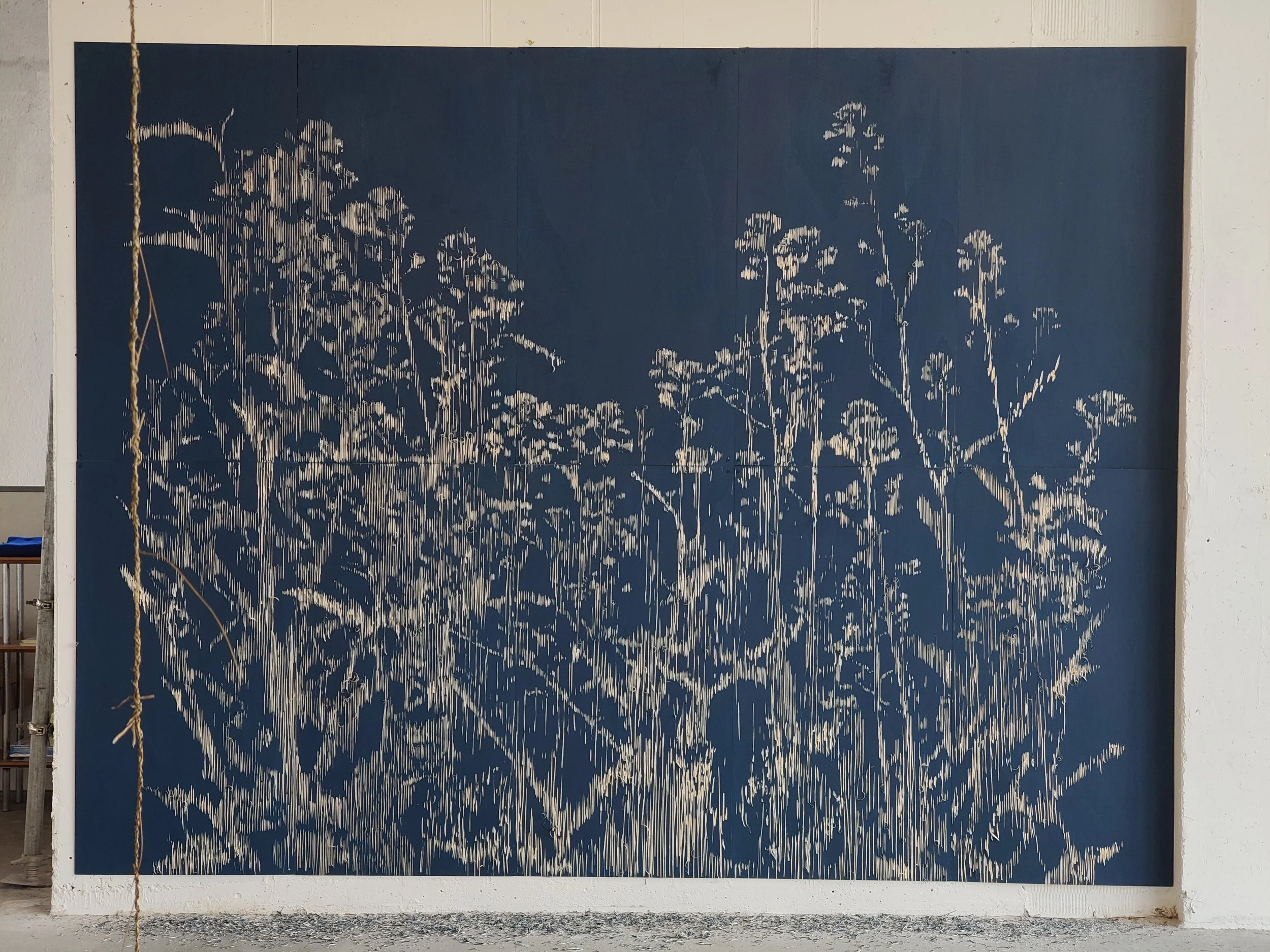
Oisín Tozer Brassica Juncea 2025 Acrylic on wood 245 x 305 x 60 cm Earthly Delights (summer 2025) Green On Red Gallery Photo by Tallon McGinn
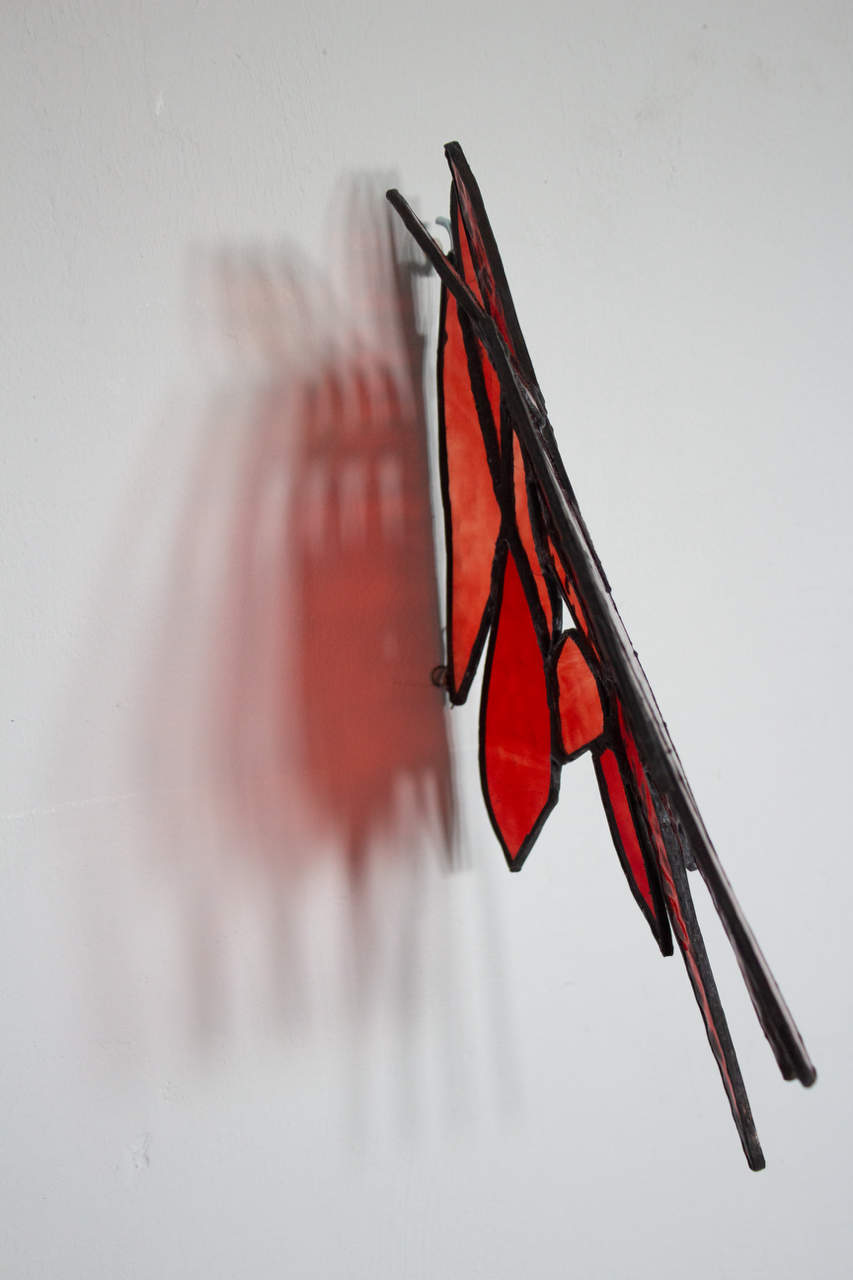
Oisín Tozer Danus (Red) 2026 Foiled glass, light 20 x 30 x 8 cm Photo : the artist
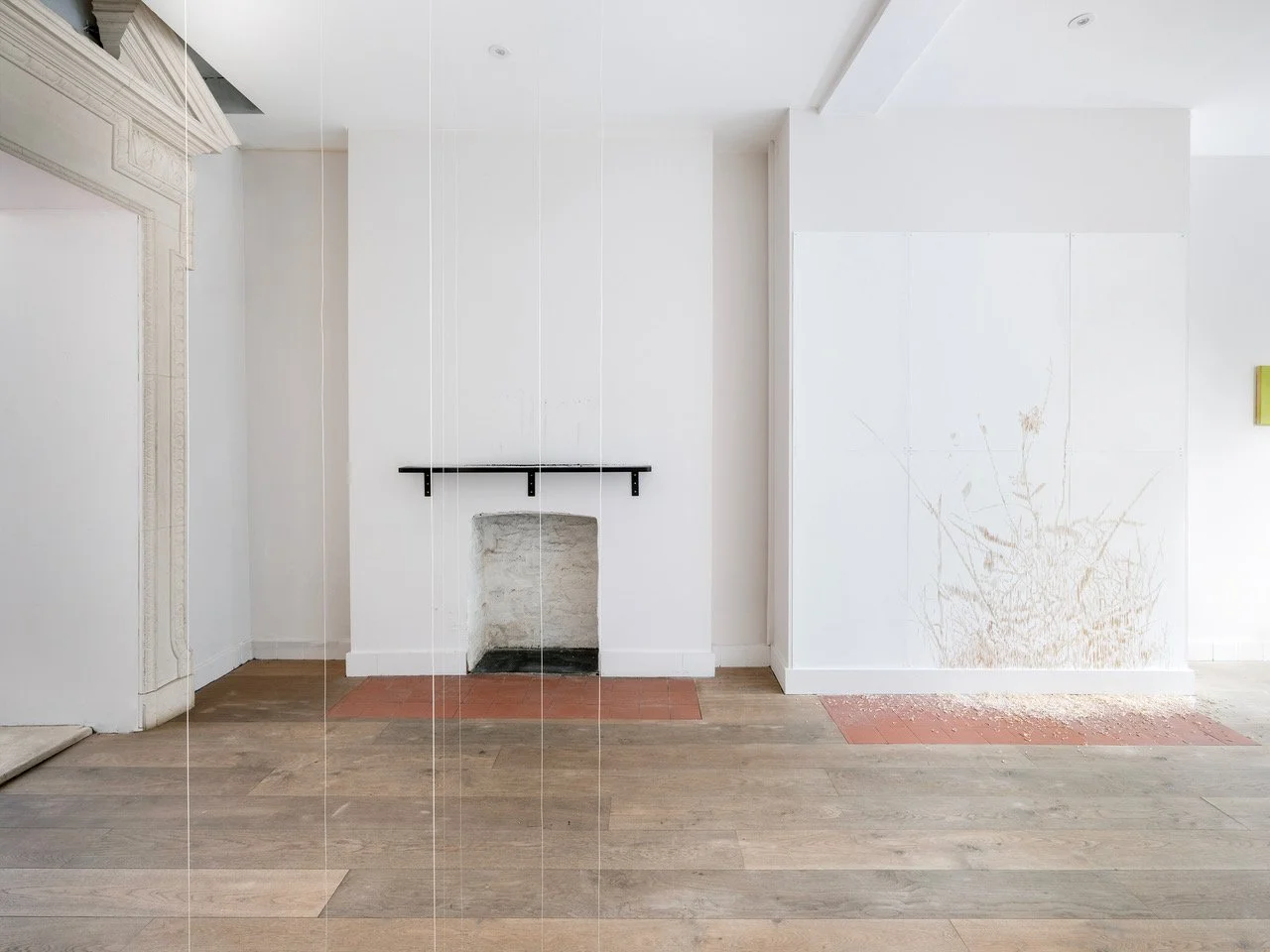
Oisín Tozer A Brightness at the Edge of Things installation 2025 Apsara Studios London Photo by Yumin Lee
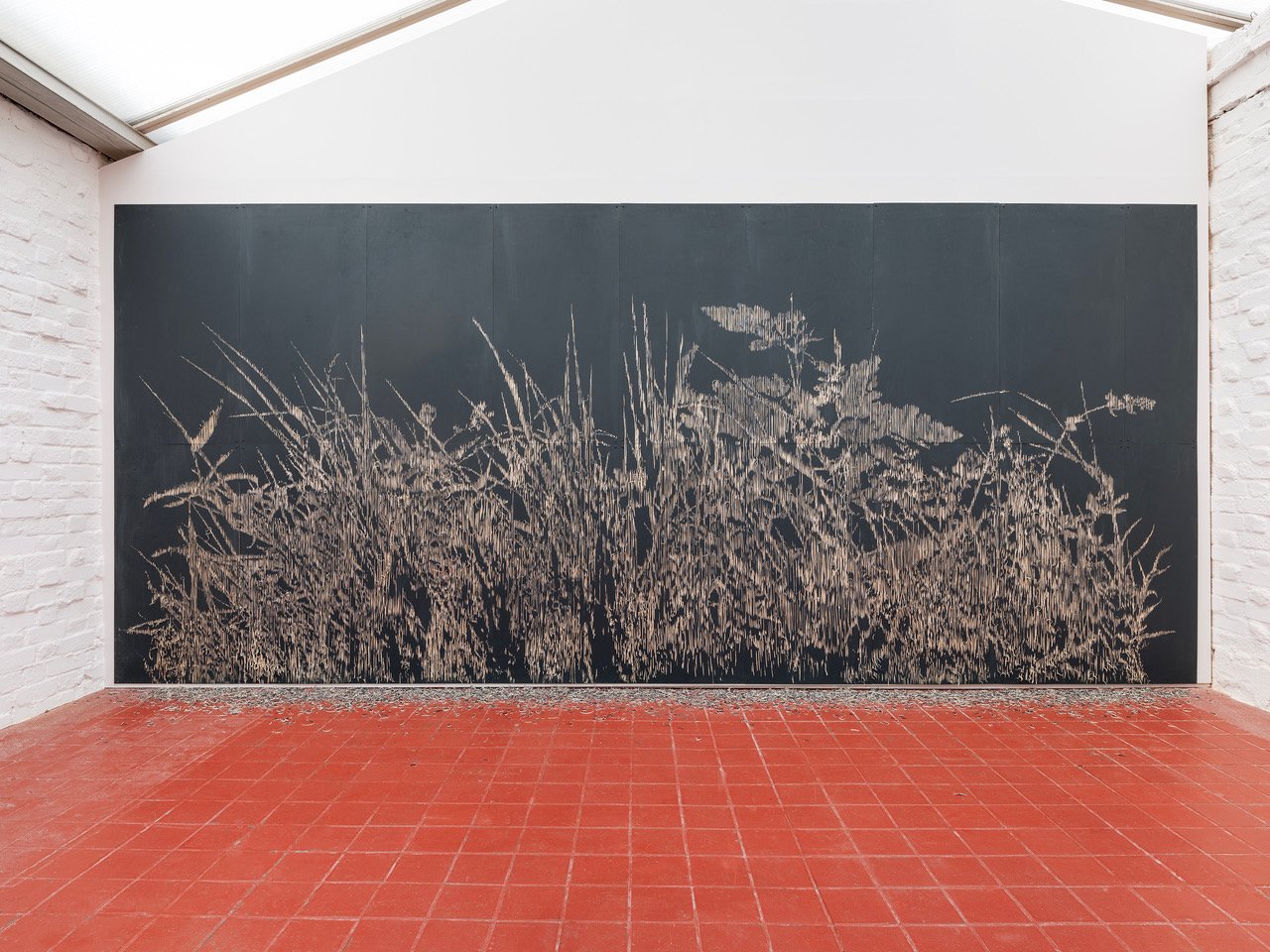
Oisín Tozer A Brightness at the Edge of Things installation 2025 Apsara Studios London Photo by Yumin Lee